
Argentina: Combating Racism, Uniting the Working Class
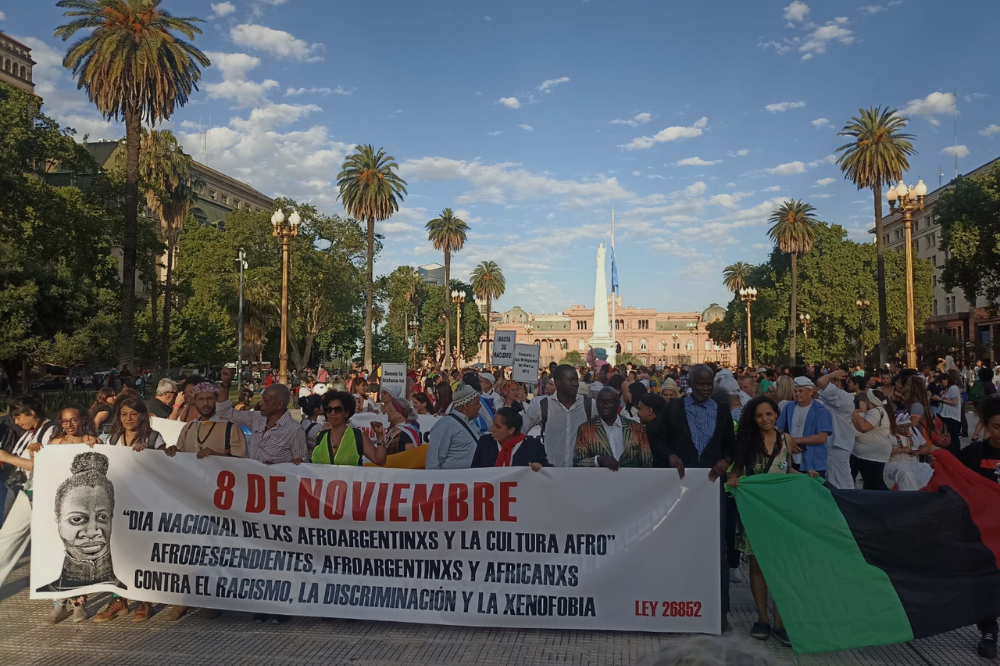
During the World Cup, following posts on social media and an article published by The Washington Post that stated there are no Black players in the Argentinian national team, in addition to various instances of racism in soccer stadiums, the idea began to spread that all Argentinians are racist because they “don’t have Black people.”
Firstly, it must be said that racism exists in Argentina and it is quite prevalent.
Second, there are in fact Afro-descendant and Indigenous people in the country who have been fighting for many years against racism, invisibility, and government policies that promote the supposed “Europeanization” of Argentina.
This article seeks to answer the following question: Does the narrative claiming that Argentinians are all white and racist actually helping combat racism?
Historical Context
To answer this question, it is important to consider the historical context and the process that Argentina and South America went through (with the exception of Brazil, which was under Portuguese rule).
African slaves arrived mainly at the ports in Buenos Aires and Montevideo, where they were transported to the rest of the territory. They also entered through Central America from 1777 and 1812. Although official records indicate that around 140,000 slaves entered through both ports, other estimates maintain that, considering illegal trafficking, this figure could be as much as 300,000.
While this seems small compared to the millions of slaves that arrived in Brazil or the United States, it was very significant for the time period. The difference does not lie in the fact that the Spanish Viceroyalty was less of a proponent of slavery, but in that a large portion of South America achieved independence relatively early, preceded only by Haiti’s revolution and independence.
This struggle for independence relied on the participation of slaves and Indigenous people, who were on the front lines. As the liberator of Argentina, Chile, and Peru, José de San Martín would state:
“The rich and the landowners refuse to fight (…). One day it will be known that this homeland was liberated by the poor and the children of the poor, our Indigenous and Black people, who will never again be anyone’s slaves.”
After the defeat of Spanish colonial rule, the slave trade was banned in 1812, and in 1813 the Ley de Libertad de Vientres (Free Womb Law) established that all children born to enslaved women would be born free.
The so-called “Rescue Law” was also enacted, which required slave owners to hand over 40 percent of their slaves to the army, thereby ensuring that the bourgeoisie would not have to send their own sons into battle. Another provision stipulated that any slave who served five years in the military would be granted freedom—a promise that, with few exceptions, was never fulfilled.
As early as 1801, militia units composed of people of African descent—known as the Grenadier Companies of the Brown and Black—had been formally established. When the First British Invasion occurred in 1806, the participation of Black soldiers was crucial to the defense of Buenos Aires.
Between 1806 and 1870, the community of African descent participated in virtually all the armed conflicts that took place in the territory. This was one of the main reasons for the sharp decline in its population, although it by no means justifies calling it a “disappearance.”
To cite one example, between 1816 and 1823, of the 2,500 Black soldiers who set out on the Crossing of the Andes, barely 143 returned alive. It was common to encounter survivors of these wars begging on the streets of Buenos Aires with mutilated limbs.
According to the first census conducted in 1778 for the entire territory of the Viceroyalty of the Río de la Plata, the population classified as “Blacks, Mulattos, Brown, and Zambos”—both free and enslaved—accounted for 37% of the population.
That same census recorded very high percentages in various jurisdictions: Santiago del Estero (54%), Catamarca (52%), Salta (46%), Córdoba (44%), Mendoza (24%), La Rioja (20%), San Juan (16%), Jujuy (13%), and San Luis (8%). In the city of Buenos Aires, 28% of the population was of African descent.
The Invisibilization of the Afro-descendant Population as State Policy
Part of the “whitening” policy promoted by the Argentine state consisted of encouraging mixed marriages, primarily between Afro-descendants and Indigenous peoples, as a mechanism to dilute those identities within the general population.
The construction of a white, European, and “civilized” Argentina, distinct from the rest of Latin America, was a state policy that can even be observed in the National Constitution. Article 25 states:
“The federal government shall encourage European immigration; and it may not restrict, limit, or impose any tax on the entry into Argentine territory of foreigners whose purpose is to cultivate the land, improve industries, and introduce and teach the sciences and the arts.”
This approach was further developed during the administrations of Mitre and, especially, Sarmiento. The latter held openly racist views and promoted the elimination or marginalization of gauchos, Indigenous peoples, and people of African descent as part of his project to build a Eurocentric society.
In this context, people of African descent and Indigenous peoples were excluded from national censuses for decades. It was not until the 2010 census that questions designed to identify these communities were reintroduced.
The Problem of Universalizing Racism
To combat racism, we must understand the historical and social particularities of both those who perpetrate it and those who suffer from it.
Racism and discrimination in various national or ethnic conflicts are not the same as historical systems of racial segregation such as South African apartheid or segregation in the United States. Reducing racism solely to a matter of physical appearance or mechanically transferring one historical experience to another leads to oversimplified analyses.
It is precisely these simplifications that lead to conclusions such as “there are no Black people in Argentina” or that Argentine society as a whole can be simply defined as racist based on the visible ethnic composition of its national soccer team.
Recognizing the existence of racism in Argentina also implies acknowledging the history of people of African descent and Indigenous peoples, the state-driven policies of erasure, and the specific characteristics of that historical process. Only through this understanding is it possible to engage in a serious discussion about racism and combat it effectively.
Fighting Racism, Uniting the Working Class
We must combat racism in all its forms and in all places it manifests itself, as happens on a massive scale in soccer stadiums every weekend. But at the same time, we must not fail to denounce the fact that, year after year, the ability to attend a soccer stadium is becoming a privilege being taken away from the working class and reserved solely for the wealthiest sectors of society. It is also important to note that these sectors often constitute a significant part of the electoral base of the far right, represented by leaders such as Milei, Bolsonaro, and Abelardo de la Espriella, among others. Argentina, like all South American countries, is a country oppressed by imperialism. We have no chance of defeating racism unless the Argentine working class and popular sectors take this struggle into their own hands. They have already demonstrated this, serving as the vanguard in movements such as “Ni Una Menos,” the National Campaign for the Right to Legal, Safe, and Free Abortion, as well as in the fight for marriage equality.
To claim that there is no Afro-descendant or Indigenous population in Argentina simply because an article in a U.S. media outlet or a post on a social media platform owned by Elon Musk says so only serves to set back the struggle of these peoples and to strengthen a reactionary, far-right discourse, such as that represented by Milei and Trump.


