
Orbán and the gordian knot of Ukraine
Lately, although Trump’s military operation in Venezuela, the threats to Greenland, the social explosion in Iran in the face of the Ayatollah’s tyranny’s repression and the continued genocide in Gaza dominate the global agenda, Ukraine remains one of those powder kegs and silent carnages amidst the earthly chaos, under the skies.
The class struggle in Europe, with global repercussions, is incomprehensible if one fails to look with horror and objectivity at a convulsive epicenter: Russia’s invasion of Ukraine (2022), about to complete its fourth year of fighting, from February 24th until this 2026. Since then, Putin’s lightning plan to colonize the territory as part of his strategy to regain the former regional sphere of influence in Eastern Europe has failed. Meanwhile, the Ukrainian people continue to resist, bravely and tragically, with a dramatic but conservative toll of ~70,000–140,000 casualties; the opposing side has accumulated ~220,000–350,000 dead.1
What has been the policy and degree of influence of Viktor Orbán’s Hungarian government regarding the war in Ukraine? How does Orbán position himself in relation to Western imperialism and to Putin’s regional Russian power? What class position do European, Hungarian, Russian, and other workers around the world need to adopt to untie the Gordian knot of the Russian-Ukrainian conflict in their favor?
Pseudo-neutrality, convenient business, and discontent
Since 2018, Hungary has been experiencing a progressive deterioration in living conditions, further aggravated by the war in Ukraine. These are the lingering effects of the catastrophe stemming from the capitalist restoration of 1989 and the end of the economic boom following the 2007-2008 global capitalist crisis, exacerbated by the COVID-19 pandemic. All of this fuels social discontent, increases economic instability, and intensifies protest voting.
The ruling Fidesz party, although in power for 15 years under Orbán’s uninterrupted leadership since 2010, has failed to resolve social issues. Despite this, inflation remains volatile, and both the cost of living and housing rents remain high in the gentrified capital, Budapest. Unemployment rates also persist, while Hungary has the second-lowest annual minimum wage in Europe (2023), even though its population works three times longer than the European average.2 This is compounded by the Hungarian forint (FT) having depreciated by half its value over the past 20 years against the euro.3 Similarly, healthcare is precarious and public services are deteriorating. Meanwhile, young Hungarians have migrated abroad, numbering 41,294, and the migrant workforce, totaling approximately 100,643 people, is largely overexploited in industry and services (Vietnam, Ukraine, Romania, China, India, South Korea, Slovenia, Turkey, Mongolia, and Russia, etc.), with roughly 65,389 workers (2024).4 Finally, this situation is aggravated by the embezzlement of funds and the repeated corruption scandals that have affected the ruling faction.
With the aim of pursuing, by any means, an “indefinite” and irregular reelection in the regional and presidential elections of April 2026, the right-wing populist rhetoric, embodied in the figure of Orbán, seeks to channel discontent and win the hearts and minds of the Hungarian people and the workers through persistent nationalist propaganda and dirty campaigns deployed in the media, on billboards, in public institutions, and in businesses. Orbán’s Trumpian slogan is that of a “Hungary First,” and he presents himself as a mediator of “peace,” in the same way that Donald J. Trump defines himself: the imperial peacemaker, master and lord of the world.
Thus, Orbán’s priority and pragmatism consist of preserving the profits of large Hungarian and foreign capital, both in its relationship with its main trading partner, Germany and the European Union —of which Hungary is a dependent country— and in maintaining strategic business with Russia: the energy supply of gas, oil and nuclear technology (Paks II) for the production of electricity, as well as with the Turkish corridor in eastern Europe, especially in the winter season.
It is precisely the lucrative energy agreement, with special prices, with Putin’s Russia that makes it tolerable for Orbán to abandon the lives and sovereignty of the Ukrainian people, as well as that of the Hungarian- Ukrainian diaspora—some 80,000 people living in Transcarpathia, on Ukraine’s western border—to their fate. Hungary’s acceptance of Ukrainian immigrants responds, in most cases, to the need for cheap labor and the acquisition of EU funds associated with the restricted quota of Ukrainian refugees, which ranges between 47,000 and 62,145 people, according to figures from UNHCR and Human Rights Watch. The foreign policy of the Orbán regime, as Putin’s agent—even though it appears as neutral and a mediator in the Russian-Ukrainian conflict—is, objectively, functional both to the material interests of the Russian invader and to those of the convenient Hungarian bourgeoisie that benefits from this calculated and unstable balance.
In fact, Orbán infamously argues that, with Ukraine’s current GDP, it is not a sovereign state, thus fueling the Russian colonialist discourse that considers not only the illegal appropriation of Crimea, Donetsk, and Luhansk in 2014 legitimate, but also presents the negotiation of the partition of Ukraine itself and the handover of its natural and social assets as the “best diplomatic solution,” in the manner of a “Roman imperial peace” to the liking of his ally Trump and the European imperialist powers—Germany, France, and the United Kingdom.
Apparently, for the wise Prime Minister, the Ukrainian people—like the Palestinians—have no right to exist and live freely in their historical territory. It is a tradition of the failed conservative forces in Hungary, with their nostalgia for the imperial past, to try to profit from the misfortunes of their neighbors through unsavory alliances and the potential partitioning of Ukraine for their own benefit. Hence the profound incoherence of Orbán’s sovereignist discourse: he glorifies the self-determination of the Hungarian people in the face of the former Soviet occupation in the brief 20th century, but today he tolerates the Russian capitalist invasion of a brother country, the impact on the lives of more than 80,000 Hungarians in Ukraine and the Israeli genocide in the Middle East.
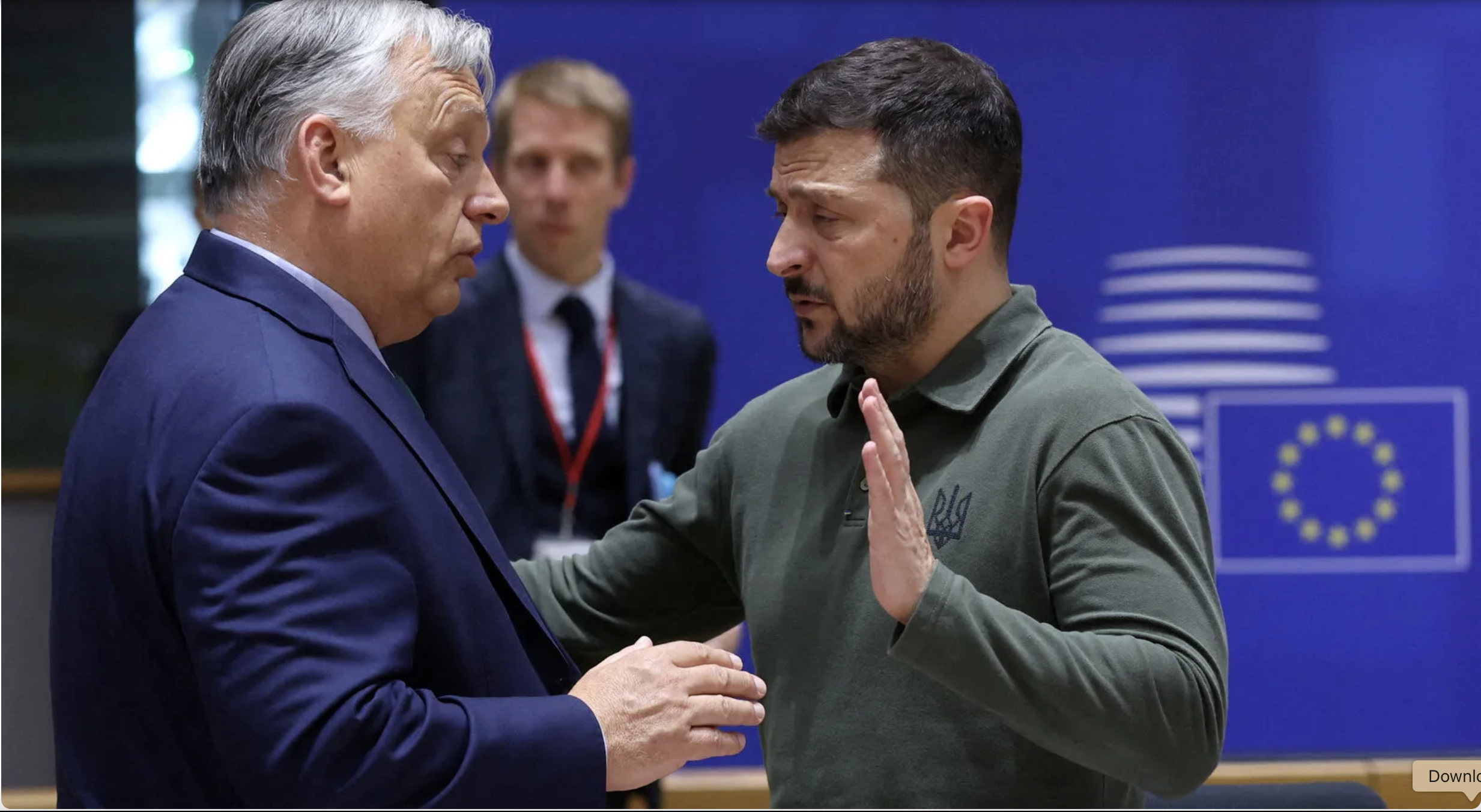
Viktor Orbán is berating Volodymyr Zelensky, the current president of Ukraine, demanding his conditional surrender, that he abandon his “desperation” to defend his country, and that he sit down to negotiate with his counterpart Putin to “seek peace,” which is nothing more than accepting his partition and capitulation by other means. This is an absurd and cynical position for someone who, like Orbán, claims to uphold national sovereignty: it would be equivalent to asking the Hungarian people not to fight—weapons in hand and with all their might—if they were invaded by a foreign power with nuclear capabilities that sought to balkanize its sovereign territory and seize it.
New populist right and peace of the powerful
In a policy of the fox in sheep’s clothing, Orbán accuses the European Union—of which Hungary has been a member since 2004—as well as Zelensky, the “oligarchic den” of Brussels with its spokesperson, the German Ursula von der Leyen, NATO’s security forces —to which Hungary has belonged since 1999—and the man he considers his puppet, the opposition leader of the Tisza party and former Fidesz member, Péter Magyar, of wanting to raise taxes and the cost of living to finance the war in Ukraine, and even of intending to unleash a new world conflagration. “Hungary will not be dragged into a world war for the third time” (Harmadszorra nem rángatják bele Magyarországot egy világháborúba), he declared with demagogic rudeness and determination on the front page of the national daily Magyar Nemzet (September 13, 2025).
Viktor Orbán labels his opponents as irresponsible warmongers and terrible stewards of public finances. He, in contrast, presents himself as the protector of the people, a statesman of peace and equanimity, concerned with the social welfare of his people and with domestic affairs as his first—and almost only—priority, above any global or regional issue. This, however, does not prevent him from posing as a skilled player in the diplomatic arena, acting as an emissary-mediator between Trump and Putin in the Eurozone and in international conflicts.
Orbán delivered a public speech on Hungary’s National Day (October 23, 2025), commemorating the 1956 anti-bureaucratic revolution against Rákosi’s Stalinist machine and Soviet tanks, a revolution now reinterpreted and appropriated by the conservative narrative of the new populist right. According to an independent report by Andrea Horváth Kavai for Telex, before thousands of supporters—mostly elderly—the long-serving Prime Minister dramatically and confidently declared a series of striking phrases: “We don’t want to die for Ukraine, but we do want to live for Hungary”, “Brussels has run out of money. There is no money, but they still want to go to war”, “Candidates to form a puppet government sent here by Brussels. We have to tell them that Brussels is not good today, but will bring us calamities” and “In 1956, the question was: freedom or servitude; today it is: war or peace”.
Orbán’s government, increasingly mired in an authoritarian drift, has exercised considerable veto power and a wide margin of diplomatic maneuvering within the European Union: it has blocked imperialist economic sanctions against Russia, hindered the development of an independent energy industry, disapproved of Zelensky’s Ukraine’s accession to the EU, reinforced its anti-immigration policy, and curtailed effective military support for the armed resistance of the Ukrainian people.
The right-wing neo-populist phenomenon of Orbán and other figures of the nationalist retreat (Le Pen, Meloni, Abascal, Wilders, Weidel, Kickl, etc.) expresses the deep contradictions of the European bourgeoisies of the west and east, as well as the manifest crisis of European imperialism and its hegemonic project as a bloc, in decline, both of the EU and the UN, after having achieved a unified strategic victory with the USA with the fall of the socialist bloc and the recovery of those states and markets by imperialist capital.
Consequently, Orbán acts as a subservient bridge and circumstantial mediator between the regional alliance of the new populist right, Putin in the Kremlin, China’s emerging capital, Trump’s aggressive US imperialism, and Netanyahu’s Israeli Zionism. His political positioning seeks to distance himself, relatively speaking, from the imperialist powers of the European troika (Euroscepticism) and from the dependent states of Eastern Europe, subservient to the EU and claiming to be its peers, in order to draw them into a new economic and geopolitical alliance.
Hence, Orbán, along with Bulashenko of Belarus, at the recent Davos Economic Forum, readily accepted the role of a puppet mediator for the Trump-Netanyahu “Border of Peace” initiative, as a counterweight to the ineffective EU- led UN. This sacred alliance seeks to disarm the Ukrainians and Palestinians through diplomatic, military, and negotiation means, with a view to an eventual conditional surrender that would lead them to accept the peace of the grave (Pax Romana), the peace of their oppressors, and to relinquish part of their land’s integrity and dignity. Such is Orbán’s diplomatic method for untying the Gordian knot: a method at the service of the pacification of the powerful, not of peace between sovereign peoples.
Untying the knot, a solidarity alternative of peoples
Faced with this unfortunate foreign policy of Orbán, American capital, and Russian big capital, the Hungarian working people and the more than 80,000 Hungarians in Ukraine who are being affected by the Russian military invasion, as well as the European peoples of the west and east, need to demand that their governments welcome Hungarian and Ukrainian refugees in dignified conditions and without reactionary restrictions, especially those who are in the worst humanitarian situation. Likewise, they must provide protection to Russian defectors and political prisoners of the Putin authoritarian regime. To achieve this, it is necessary to cancel the external debt owed to European banks and promote greater social investment in employment, health, education, and housing.
In turn, and contrary to a supposed neutrality that serves colonization, it is necessary to publicly reject the impact of Russian military operations, which also target the Hungarian national minority in Ukraine, and the neocolonial appropriation of the Ukrainian people—and the integrity of their nation—by both the Russian occupation forces and the plundering of northern pirates, as well as the EU’s deceptive promises of reconstruction, development, and corporate investment.5
Consequently, under social pressure, the most powerful EU countries, without any tax burden or militaristic rearmament, and through a common fund, need to send readily available heavy weapons to the Ukrainians so they can defend themselves and be free. This must be done without any NATO intervention, which is not a peacekeeping force—as Zelensky mistakenly believed when applying for membership—but rather a nuclear-armed military coalition aimed at the imperialist military control of Eastern European markets by the US and the EU, and the recolonization of the world.
For genuine peace without annexations to exist in a world order in crisis and populated by monsters, a radical policy of solidarity is required, emanating from the workers—native and immigrant—and independent of all imperialist powers and oppressive capitalist countries.6 As Latin Americans Ernesto Che Guevara (1964) and Gioconda Belli (1979) professed, greater fraternity and solidarity are needed, which is the tenderness of the people, and not to trust “even a little bit, not at all” in imperialist spokespeople.
In a recent tweet, responding to President Zelensky’s speech in Davos, Viktor Orbán, like a lapdog emissary of Trump, warned him: “Life itself will resolve the rest, and everyone will get what they deserve” (X, 1/22/2026). It is also worth reminding the all-powerful Prime Minister of two emancipatory maxims of modernity and internationalism: “A people that oppresses others cannot be free” (Dionisio Inca Yupanqui, 1811) and “The tragedy of your neighboring people tomorrow may be your misfortune if you fail to come to their solidarity aid today”.
Footnotes
- Approximate estimates based on The Russia-Ukraine War Report Card (21/1/2026).
- See analysis one and two by columnist Bálint Csontos for the Daily News Hungary newspaper.
- Analysis by GKI Economic Research Co, used by journalist Molnár Zoltán in the independent media outlet Telex (7/9/2024).
- Official data from the Hungarian Central Statistical Office (KSH) referenced by editor Mercédesz Hetzmann for the conservative newspaper Daily News Hungary (9/11/2025), first used by the economic portal Pénzcentrum (4/11/2025).
- Read Preventing the Partition and Plunder of Ukraine (28/8/2025) by Taras Shevchuk on the IWL-FI website.
- An anti-imperialist policy is outlined in the Resolution on Ukraine of the XVI World Congress of the International Workers League.


