San Francisco teachers strike — and win!
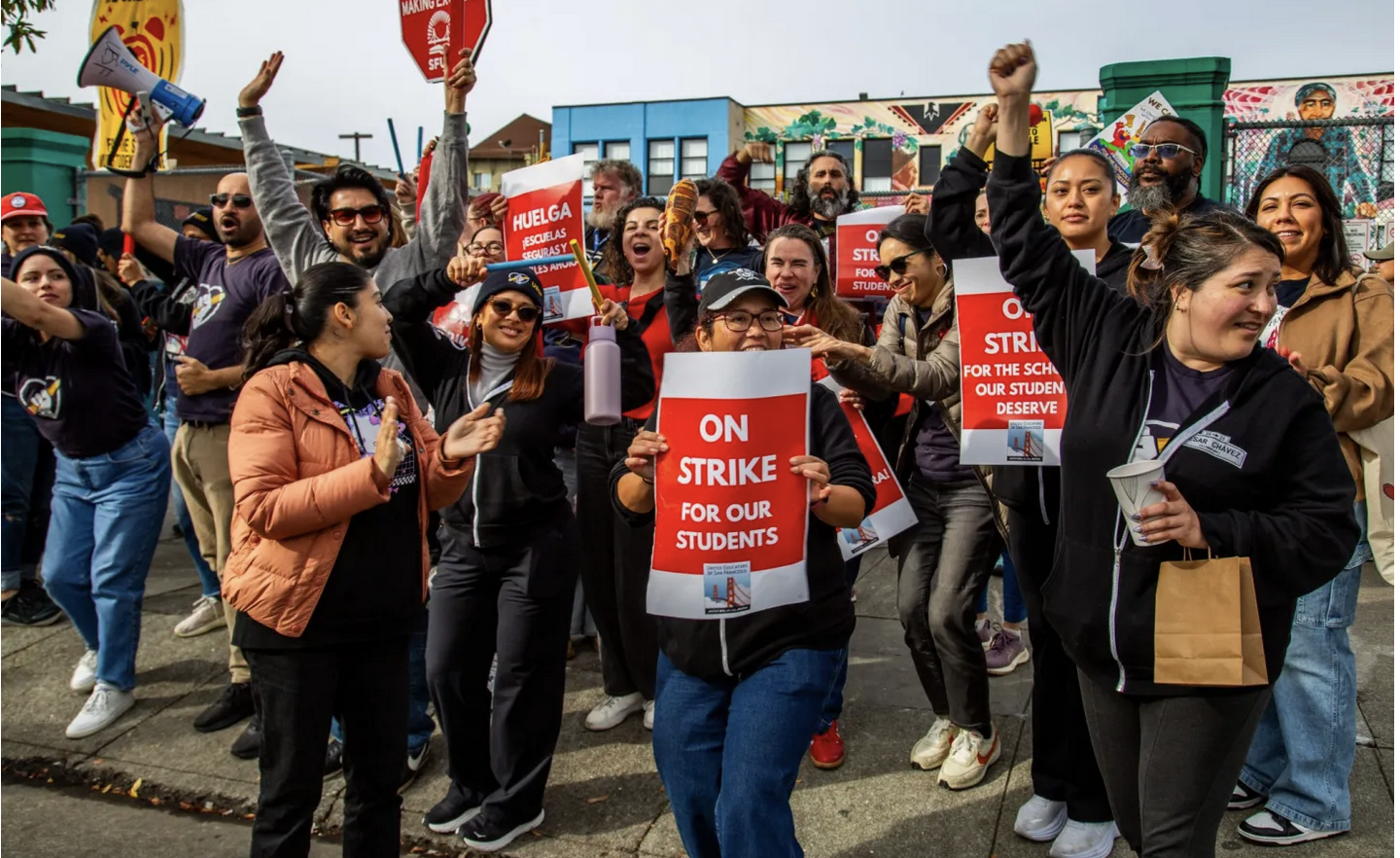
San Francisco educators and school workers have won our first strike in nearly 50 years. The strike galvanized our entire union, garnered support from the City’s working-class, and forced a long-intransigent district to concede on our key demands for better working and living conditions.
Our 6000 members held the picket lines for four days, between Feb. 9 and 12. We demonstrated that through strike action, workers can win improvements in our lives. Such a victory further empowers our union to continue the fight for fully-funded schools and in defense of our democratic rights in an increasingly authoritarian society.
During the months of negotiations, the San Francisco Unified School District said that it was broke and that it could not meet our demands. Our union called them on their lie and showed via our own financial analysis that the district was actually sitting on a huge reserve fund that could be invested in our schools. The district’s responses to our proposals fell far below what we deemed acceptable. Thus, after two strike votes held in December and January, respectively, our members voted overwhelmingly to strike—for the first time since 1979. Our leadership set the strike date for Feb. 9, even after newly-elected Mayor Daniel Lurie urged the union to hold off for three days.
Between early morning and midday, union members alongside community supporters and students picketed in front of our school sites. We marched, chanted, broke bread, and connected in ways never before possible. Our workloads as educators force us to remain in our classrooms, making the experience often isolating. This strike rebuilt unity and solidarity around the fight for our schools and our students.
While our bargaining team indicated its willingness to negotiate and hear reasonable proposals from the district in the days before the strike, the district responded with insulting proposals far below what we needed. Very significantly, two other unions declared a sympathy strike when we set our strike date. SEIU Local 1021, representing our school’s cafeteria, clerical, and janitorial staff marched alongside us in their signature purple colors. United Administrators of San Francisco, the principals’ union, also became the first administrators’ union in the history of California to declare a sympathy strike with a teachers’ strike.
In the afternoons, our members and supporters met at different points in the City—Dolores Park, Ocean Beach, and the Civic Center—to express our unity and energize our members to continue the fight. As we traveled on MUNI or BART towards our meeting locations, the City’s residents honked their horns, waved at us, and showed their love. Regardless of the capitalist media’s attempts to drive a wedge between our union and the community we serve, we had the sympathy of the City’s working-class. Parents, students, and community supporters showed up to picket, to march, and to bring needed supplies to sustain the strikers.
One exciting example of community solidarity occurred in San Francisco’s Excelsior District, a working-class, immigrant neighborhood in the city’s southeast. A coalition of community organizations and non-profits organized a protest titled “Excelsior Community Action: In Solidarity with the UESF Strike! Youth, Families and Community are Strike Ready to Demand a Fully Funded Public Education!” Approximately 100 youth and community organizers held speeches and a rally in the neighborhood’s main intersection, framing the strike as one step in a larger struggle of all the City’s workers against the billionaires who continue to accumulate more power and profit at our expense.
After four days of tiring but energizing strike action, our union declared victory. We won salary increases for all members, sanctuary district protections for immigrant youth, guardrails for AI use in schools, full-time hours for security guards, and fully-funded district health care. Whereas union members with families were paying up to $1500 a month on health coverage, our strike forced the district to cover that expense. In a country where health-care costs are rising and becoming a central concern for workers, our strike can inspire others to engage in similar action.
While salary increases for certificated staff will barely keep up with inflation, it is important that our lower-paid classified educators won a higher percentage increase that begins to bridge the wide gap between certificated and classified staff.
San Francisco is one of the country’s wealthiest regions and is increasingly so as a result of the boom in the artificial intelligence industry. The cost of housing and living increases for workers while tech capitalists invest billions in infrastructure to develop cutting-edge technology to lay off workers and surveil our communities. Nationwide, inequality in the United States has reached levels not seen since the Great Depression of the 1930s. Our victorious strike is a beacon of hope for all workers that collective action can begin to shift the relation of forces between the haves and the have-nots.
Now that our strike is over, we will need to turn our attention to addressing the severe budget cuts the district will try to implement this school year. SFUSD has already announced plans to drastically reduce newcomer program services for newly arrived immigrant students at three schools: San Francisco International High School, Visitacion Valley Middle School, and Mission Education Center. Union educators, community groups, families, and students have begun a campaign calling on the district to pause cuts for one year. We must use our newfound collective strength to oppose all cuts, in particular those against immigrant students.
While the district’s concession around sanctuary district policies didn’t require economic investment and is thus symbolic, it nonetheless is a victory for our side given that the district originally refused to bargain over this demand which they deemed to be outside of the scope of bargaining. Our winning of sanctuary district policies must be applied to the concrete defense of immigrant students’ needs, and to connect this fight with the broader fight against austerity, arrests, and deportations of immigrants, and growing war budgets to threaten workers around the world, such as in Venezuela, Iran, and Cuba.
Finally, there are tens of thousands of other educators in California poised to strike. From Oakland, the Sacramento-area, to Los Angeles, we’re in the midst of a strike wave of educators across our state fighting for the same things. While we hope for similar wins for educators in these other locals, we must move beyond local fights against local districts. We need to prepare a statewide educators’ strike against the state.
Local fights against individual districts are limited due to the small pot of money we have to fight over. To introduce the fundamental changes in our schools—such as significant reductions in class sizes, appropriately staffing our schools with educators and support staff, and funding robust student programs—we must coordinate with the hundreds of thousands of educators across California and their respective locals to tap into state funding sources, which is where about 60% of our funds come from.
The Red State Revolt, where educators in states such as West Virginia and Arizona engaged in statewide strikes against their states in 2018 that resulted in significant increases in public school funding, are models for us to build upon.
First published here by Workers’ Voice
Photo: Mariana García / San Francisco Local