
Venezuela | Agreements and Legal Reforms to Hand Over Oil and National Sovereignty
After the criminal attack perpetrated against the country in the early hours of January 3, 2026, Donald Trump, head of US imperialism, made several announcements making clear his real intentions and the true reasons why he maintained months of military siege and finally carried out the military incursion into Venezuela, kidnapping the then head of state, dictator Nicolás Maduro, and his wife Cilia Flores.
Thus, shortly after the military incursion into Venezuela, Trump, setting aside his arguments about democratic freedoms and the fight against drug trafficking, went on to assert that the U.S. government would now directly administer and oversee Venezuelan oil, which he had previously claimed had been stolen by Venezuela from the U.S., assuring that they would be recovering what belonged to them. He then announced that Venezuela would deliver between 30 and 50 million barrels of oil to the US.
These statements by the US president were subsequently backed up by US Energy Secretary Chris Wright, who said: “The United States will control the sale of Venezuelan oil for an ‘indefinite’ period and will deposit the money from these transactions in accounts controlled by Washington” (DW, January 7, 2026).
Chris Wright elaborated on this at a Goldman Sachs energy conference in Miami: “…we are going to put the crude oil coming out of Venezuela on the market, first this stuck oil, and then, indefinitely, going forward, we will sell the production coming out of Venezuela on the market” (DW 01/07/2026); adding, “…we are working directly in cooperation with the Venezuelans, following President Donald Trump’s announcement last Tuesday that Venezuela will deliver between 30 and 50 million barrels of oil to the United States for sale on the U.S. market. The U.S. will allow the sale of Venezuelan crude oil to U.S. refineries and around the world, but those sales will be made by the US government and deposited in accounts controlled by it. From there, those funds can return to Venezuela to benefit the Venezuelan people, but we need to have that power and control over oil sales to drive the changes that simply must happen in Venezuela…” (DW 01/07/2026).
In addition to this, the US government established conditions such as limiting, controlling, and, where appropriate, directly prohibiting the sale of Venezuelan oil to rival imperialist powers such as China and Russia, suspending oil shipments to Cuba, and ensuring that the purchase of supplies and products made with oil sales money is exclusively from the US.
These public announcements of negotiations with the Venezuelan government, now headed by Delcy Rodríguez, and of its collaborationism, were confirmed in a public statement issued by the state oil company PDVSA, which not only corroborated that Venezuela would sell between 30 and 50 million barrels of oil to the US, but also made it clear that negotiations with US oil transnationals would take place on the terms already established with Chevron-Texaco.
Subsequently, on Friday, January 9, Donald Trump met at the White House with the CEOs of the major oil transnationals to explain these conditions to them, propose that they invest the equivalent of $100 billion in the sector in Venezuela, and make decisions about the destination of Venezuelan oil.
In addition to this, the restoration of diplomatic relations with the United States and the reopening of the US embassy in Venezuela are underway, and there is also the possibility that Delcy Rodríguez will travel to the US to meet with Trump.
A legal reform to consolidate and deepen the surrender of oil
On January 22, 2026, the National Assembly, controlled almost exclusively by Chavismo, approved in first discussion a reform of the Organic Law on Hydrocarbons, with the favorable vote of a sector of the tiny and insignificant minority of opposition deputies; paving the way for a profound transformation in the management of the country’s oil industry, accelerating and deepening the privatization that began even under the Chávez government.
This reform is being carried out by a totally collaborationist government acting under the tutelage and orders of the US government, which for its part has no interest whatsoever in the welfare of oil workers, the Venezuelan workers and people as a whole, or national development. On the contrary, it only seeks to satisfy its political, geopolitical, economic, and military ambitions, to which end it needs to subordinate Venezuela and the rest of the continent in order to reaffirm its imperialist hegemony.
This amendment to the Hydrocarbons Law, carried out under the pretext of “modernizing the oil industry” and “attracting investment,” constitutes a qualitative leap in the course toward privatization of the oil industry and business in Venezuela, as it points toward a total opening of the oil sector to domestic and/or foreign private investment, which will no longer be required to operate in partnership with PDVSA through joint ventures. From now on, domestic or foreign partners will participate directly and make decisions on oil exploration, extraction, and marketing through so-called “Productive Participation Contracts” (PPC). These contracts grant foreign capital from imperialist transnational corporations (and minority national capital) operational and managerial autonomy in the oil business, without PDVSA’s control. This eliminates the control that the country exercised, through the state oil company, over crude oil operations and marketing.
It is worth noting that, although the joint venture scheme established by Chávez marked the beginning of an opening up of the oil industry to privatization (because transnational companies went from being simple contractors with the state to becoming partners in the oil business), under which the associated transnationals profited enormously, the hydrocarbons sector legislation, under which this scheme was governed, guaranteed until now direct state control of the exploration, exploitation, marketing, and sale of oil, either through PDVSA or through joint ventures.
The Hydrocarbons Law required a majority shareholding in the state oil company (more than 50% of the shares, although it was usually more than 60%); although this legislation had been arbitrarily infringed and violated by the Maduro government since 2015 and even more so since the approval of the so-called Anti-Blockade Law in October 2020.
The reform, carried out by the collaborationist government of Delcy Rodríguez, contrary to the provisions of the 2006 Hydrocarbons Law, allows private national or foreign companies to operate directly and without state control in the primary oil sector, i.e., in exploration and production, and also to directly market the product of these activities, thereby taking control of production and sales in the oil business and appropriating the income.
Thus, although the state can formally maintain a majority stake in joint ventures, associated domestic or foreign private capital will be able to manage operations, make technical decisions, and handle the marketing of hydrocarbons according to its own criteria, which in effect means handing over strategic control of the industry and the business. This extends to the rest of the oil sector the scheme under which Chevron already operated during Maduro’s government.
The political framework of the reform, other key aspects, and its consequences
This legal reform is contextualized within the hegemonic imperialist pretensions of the US in the continent and in Venezuela, in the inter-imperialist dispute with its competitors in the region, that is, in the US’s objectives of asserting its political, geopolitical, economic, and military interests in the region. It is in this context that we must understand it.
In addition to the strategic aspect of the reform that we pointed out above, which is, let’s say, the most relevant aspect of its spirit, it includes other key aspects, such as: the reduction of royalties that transnational and national companies must pay to the Venezuelan state, from 33.3% to 15%, and in some projects, to 20%. On the other hand, it contemplates the non-obligation to resolve disputes and controversies with companies in national courts, allowing these cases to be brought directly before international bodies, in an unprecedented display of subservience.
Similarly, it should be noted that, since royalties are a tax that companies pay to the State for their participation in oil activities, reducing them means, on the one hand, greater profits for transnational oil companies and, on the other hand, less revenue for the country.
This submissive and neocolonial reform solidifies the collaborationist and openly pro-imperialist pact between the Chavista regime, now headed by the government of Delcy Rodríguez, and the US government led by Donald Trump, giving way to a profound and structural modification of the regime of ownership and control of the country’s strategic oil resources, to the benefit of transnational capital and US imperialism. This deepens and now legalizes the privatization and surrender of the country’s oil industry and moves toward the liquidation of national sovereignty. This process began in previous years and governments.
This is a course of privatization and surrender that has been developing for years and is now being deepened and openly legalized. It is the consolidation of a course that liquidates sovereignty over the country’s most strategic resource and hands over the levers of production and marketing to the international interests of large corporations.
The continuity of a surrender
What we have just stated is nothing more than the continuity and a qualitative leap in a process that has been taking place since the government of the late President Chávez. Suffice it to recall that in 2007, with the so-called “Full Oil Sovereignty” plan, transnational companies in Venezuela became partners with PDVSA in the oil business, through the creation of joint ventures, which replaced operating agreements and strategic partnerships with a scheme of up to 51%/49% shareholding. It is important to remember that transnational companies never left Venezuela.
Under this business scheme, joint ventures were established with Chevron, Repsol, Shell, Total, China National Petroleum, Statoil, Eni, Petrobras, among others; later Mitsubishi, Lukoil, Gazprom, and Rosneft were added. Exxon Mobil and Conoco Phillips remained outside the business because they decided not to participate. In the case of the former, it filed legal claims against Venezuela before the International Centre for Settlement of Investment Disputes (ICSID).
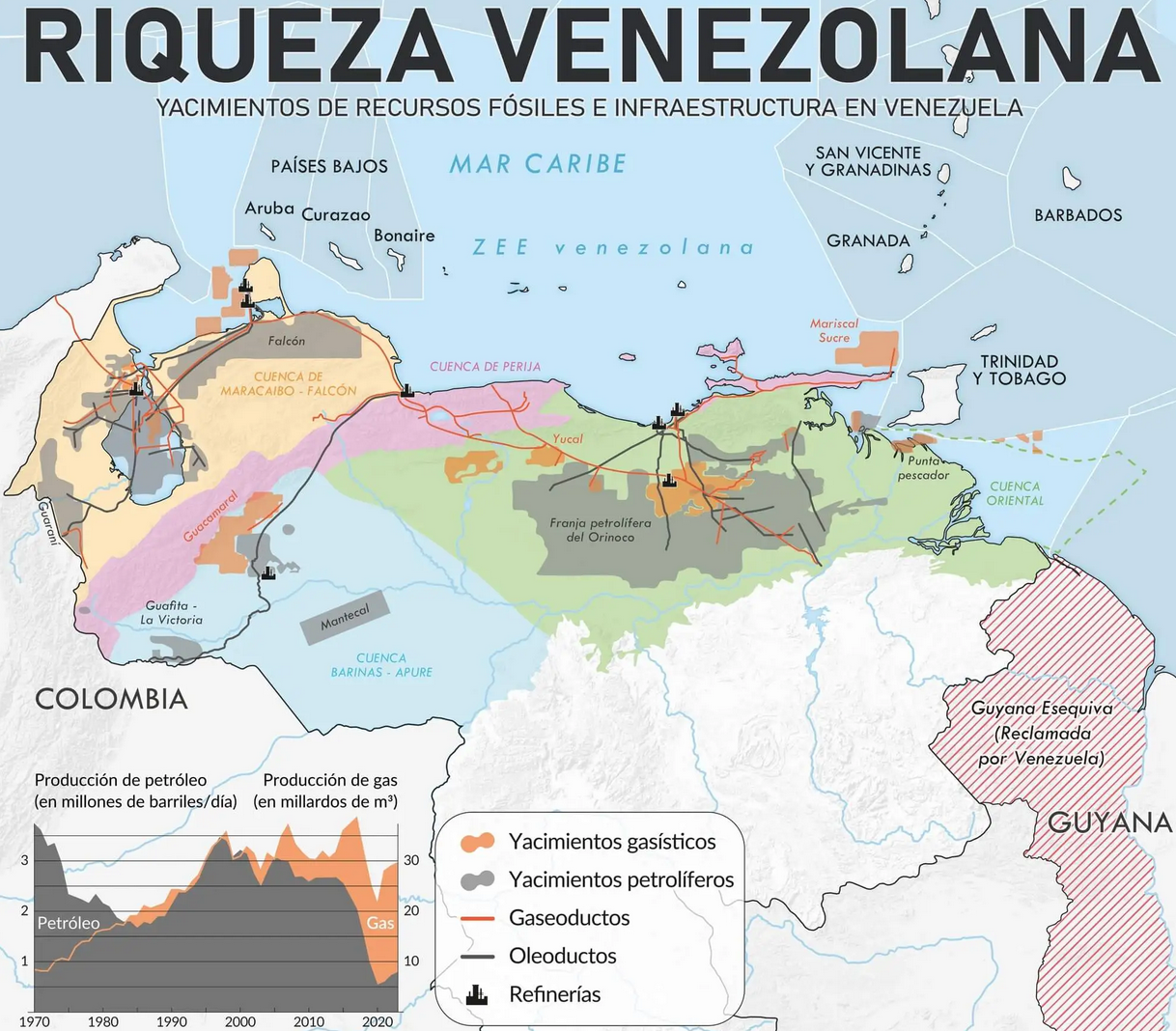
As part of this policy, in 2010 Chávez handed over several blocks of the Orinoco Oil Belt, the world’s largest crude oil reserve, to transnational corporations, thus deepening the surrender of our oil.
As a result, the enormous resources that entered the country ended up in the coffers of transnational oil companies and other sectors, in international banks via foreign debt payments, and in the pockets of the corrupt Bolivarian bourgeoisie. And within a few years, in contradiction to the enormous amount of resources it received, the country entered the worst crisis in its recent history.
Subsequently, beginning in 2018, Maduro began to implement policies that relaxed state controls on the oil business, bypassing aspects such as the requirement for a majority shareholding in joint ventures or using oil resources and assets as collateral for debts, bypassing aspects established in hydrocarbon legislation, granting transnational corporations control over certain aspects of the business reserved exclusively for the state, the greatest expression of this being the Orinoco Mining Arc agreements and the “Chevron model.”
This dynamic of surrender and privatization of oil will have harmful impacts on the lives of millions of Venezuelans. The surrender of the oil industry and the colonization of the country will mean the plundering and looting of our resources and assets, for the benefit of private capital, both national and mostly foreign, and to the detriment of the needs of workers and the humble people.
Therefore, it is necessary to prepare the struggle against the surrender and plundering of oil, and to defeat the imperialist aggression as a whole, which only seeks to impose its economic, political, geopolitical, and military interests on the sovereignty of Venezuela and Latin America, as well as on the working class of the country and the continent.
To defeat these imperialist pretensions, it is necessary to build the broadest possible mobilization of workers and the people, both in the country and in the rest of the continent and the world, as well as extensive international solidarity.


