
‘God Bless América’: Bad Bunny at the Super Bowl
The Puerto Rican Grammy winner brought only good vibes and Latin rhythms to the biggest US sports and media event of the year. That Trump and the right wing see this as an abhorrent attack on their culture speaks volumes about their pathetic racism and cowardly insecurities
Bad Bunny was announced as the Superbowl LX Halftime performer on Sept. 28, 2025. Since the artist is a Puerto Rican reggaeton superstar whose music is entirely in Spanish and has refused to book dates for his current World Tour in the United States over concerns about ICE targeting his fans, the selection drew immediate outrage from the right. President Donald Trump called it “absolutely ridiculous,” and numerous conservative talking heads blasted him for performing in Spanish and for his outspoken opposition to ICE.
Among their base of reactionary social media trolls, the response was much more clarifying. This was not about his opposition to ICE, or some sort of informed critique of his music. It was the same racial animus driving the assaults on immigrants across the country. Comment after comment attacked him as “illegal” or “not American” (despite his support for Puerto Rican independence, Bad Bunny does hold US Citizenship by virtue of being born in Puerto Rico). This is not a simple mistake that one can correct. Implied in the comment is the belief that he, and those like him, shouldn’t be Americans.
The reaction to the halftime show was decided from the moment Bad Bunny was announced as the headliner. It was decided before they knew anything beyond the language in which Bad Bunny performs. In a sense, it was decided the moment that U.S. imperialism took possession of the island in 1898, or when the Supreme Court decided in Downes v. Bidwell that Puerto Rico was “foreign in the domestic sense” and “inhabited by alien races.”
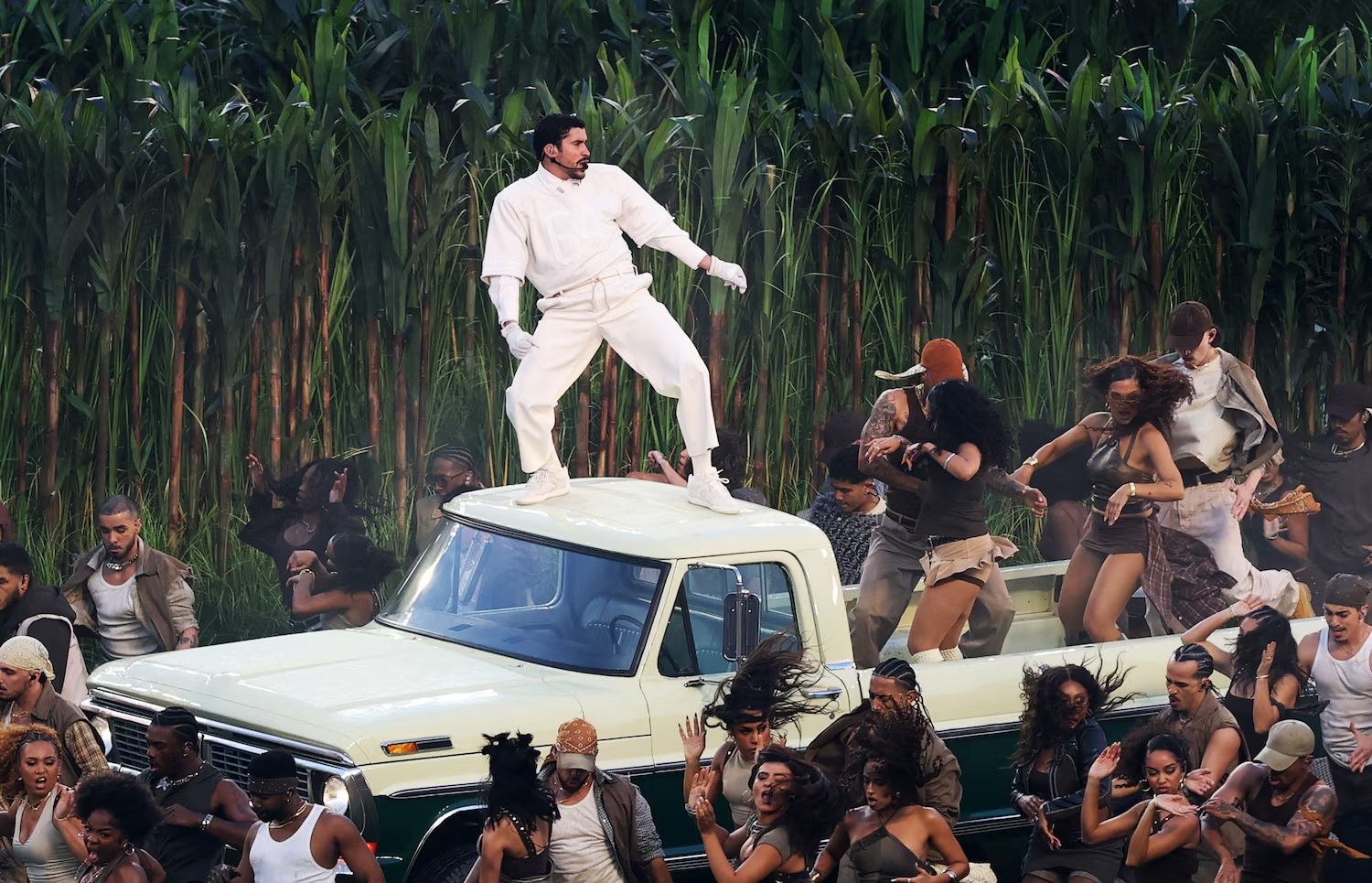
The performance, like his discography, was indeed rich with cultural and political messaging and significance. From the opening in the cane fields showing Caribbean workers on the colonial plantations to references to piragua, coco frío, and other iconic scenes of Puerto Rican life, the staging served as a visual crash course in Puerto Rican culture. While the specifics are Puerto Rican, these images are reference points not just for Puerto Rico, but for the broader Caribbean area and Latin America. This was made clear for anyone watching when, near the end of the performance, Bad Bunny appropriated the often-reactionary saying of “God Bless America,” geographically turning it on its head by listing all the countries of the Americas, South to North.
Sonically, the show started off with the most popular club-bangers that have made Bad Bunny a global superstar and his music a must for any party playlist, no matter where in the world. Of note in this section is the instant-classic “Yo Perreo Sola,” which was released during COVID and whose title and lyrics took on a special valence in that context. The song itself is an anthem for enjoying yourself and, in particular, for the right of women to go out, dance, and have fun without needing to be escorted or sexually harassed by a man. While this content is already objectionable to the repressed and repressive reactionary right, in the video released for this single, Bad Bunny is also in drag, a gesture aligned with his public statements and actions in defense of LGBTQ+ rights.
Another moment that turned the traditional dominance of Anglo-American culture in the United States on its head was the guest appearance by Lady Gaga (a long-time idol of Bad Bunny). Her role wasn’t simply to placate audiences wanting a U.S. superstar, but instead to subvert the traditional direction of tokenism and assimilation, placing Lady Gaga in a supporting role where she joyfully adapted her music to a Latin rhythm.
However, the most explicit and forthrightly political moments came in the later half of the performance, which included a guest appearance by Ricky Martin (himself a Puerto Rican Grammy winner) singing the chorus of “LO QUE LE PASÓ A HAWAii” from Bad Bunny’s most recent album. This song (in English, literally, “what happened to Hawaii”) uses Hawaii as an example of the dangers of statehood as well as tourism and gentrification. This song sparked outrage amongst pro-statehood Puerto Ricans who saw it as an implicit endorsement of independence and a cultural boon to the pro-independence political forces in La Alianza, which had recently made historic gains in the 2024 general elections.
In a clear rebuke of what is currently happening in Puerto Rico and has happened in Hawaii, the chorus says, “Quieren quitarme el río y también la playa / Quieren al barrio mío y que abuelita se vaya / No, no suelte’ la bandera ni olvide’ el lelolai / Que no quiero que hagan contigo lo que le pasó a Hawái” (“They want to take the river and the beach from me / They want my neighborhood and for grandma to leave / No, don’t let go of the flag or forget the lelolai / For I don’t want them to do to you what happened to Hawaii).
This was followed up by “El Apagón” (“The Blackout”), a trenchant critique of LUMA Energy, a joint venture between American and Canadian capital that has taken over responsibility for power distribution and transmission from the public entity that previously controlled it. The contract, which the Government of Puerto Rico signed with LUMA, was critiqued and caused a backlash due to its secrecy and the lack of public input. This has not been helped by LUMA’s consistent failures to provide the services it was contracted for or its insistence on raising electricity rates on Puerto Ricans despite continuing issues with widespread blackouts.
The song channeled the outrage of the Puerto Rican public against this imperialist looting operation, and Bad Bunny used its music video as an opportunity to produce and disseminate a mini documentary on the electricity crisis and LUMA. Likewise, the Halftime show became a platform for visualizing this saga through the vignette that saw Bad Bunny and other performers dancing atop power poles emitting electrical sparks.
As we said earlier, the show ends with a hemispheric or pan-American call for unity against the backdrop of the exclusionary, belligerent, and imperialist vision of America propagated by the U.S. right wing. While one could view this gesture as simply an inversion of U.S. exceptionalism, it has its own history and logic in the politics of Latin America. In a sense, Bad Bunny was harkening back to the calls for pan-American unity and solidarity made by the likes of José Martí in “Nuestra América”—a call that is not exclusive of the United States and Canada but that takes the Americas for their totality—including, representing, respecting, and defending all.
Finally, one must address the counter-programming set up by the far-right Turning Point USA of Charlie Kirk fame. Just on the numbers, Bad Bunny’s halftime show was watched by the most viewers in Super Bowl history. If we trust that all the views of the Turning Point USA event are real, then the Bad Bunny performance pulled over 130 million more viewers.
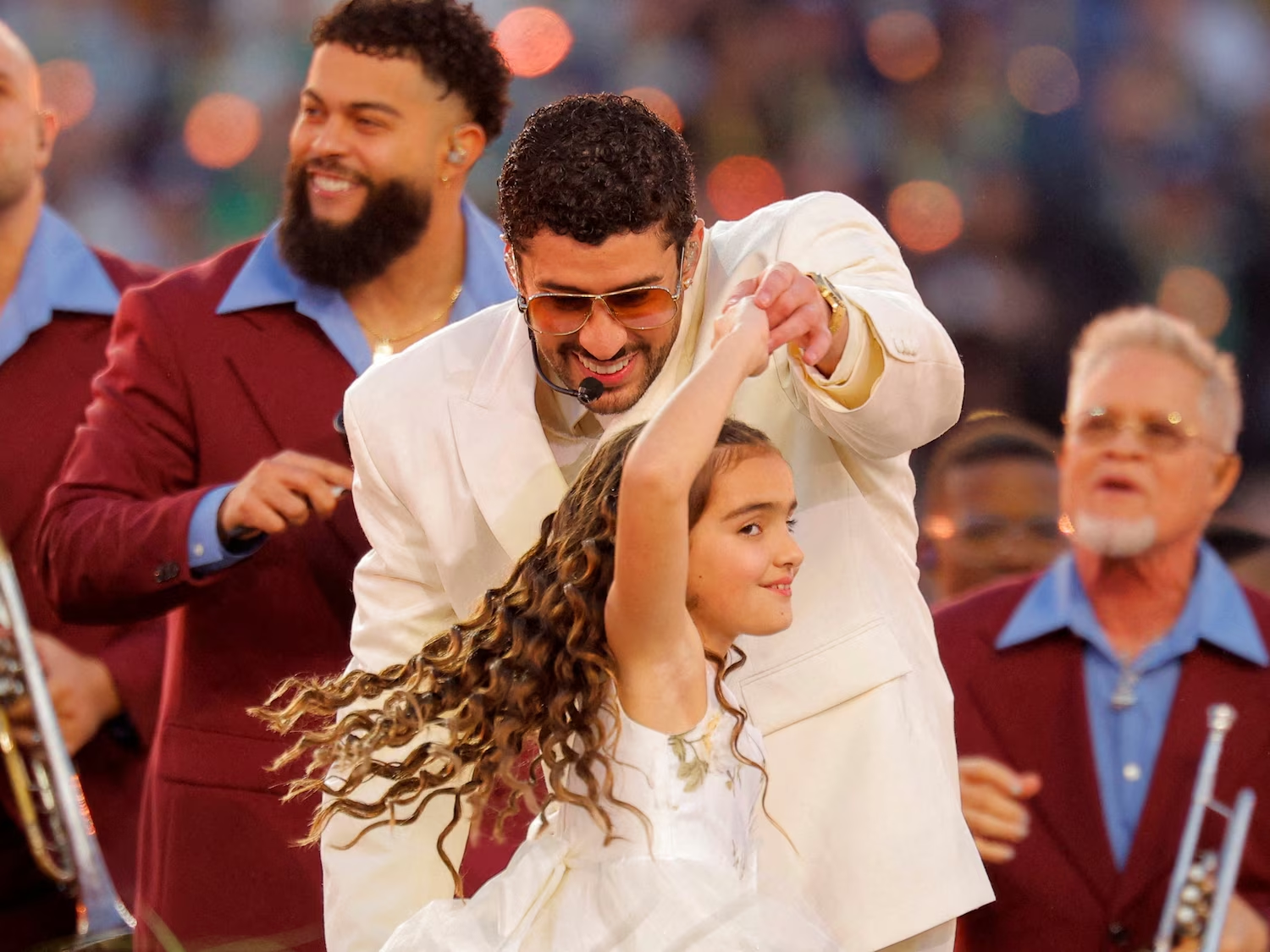
What’s more, the juxtaposition of the two events could not have created a clearer narrative. Kid Rock, a has-been who was last really culturally relevant over 20 years ago, lip-syncing in a pre-recorded performance for the right-wing show feels like an apt metaphor for the politics of an aggressive, decaying, sundowning empire. Compared to the youthful, relevant, multicultural, and joyous performance of Bad Bunny, we see the old world and new world of Gramsci. Now is indeed the time of monsters, but there is hope. When he handed his Grammy to a young boy—meant to represent his past self —Bad Bunny was not just handing it to the past, but to the future.
Photos: (Top) Carlos Barria / Reuters; (Below) Mike Blake / Reuters


