
A Theoretical and Political Review of Suicide Attacks in Pakistan
The violent contradictions of the Pakistani state are best confronted with a revolutionary constituent assembly that transfers power to the masses
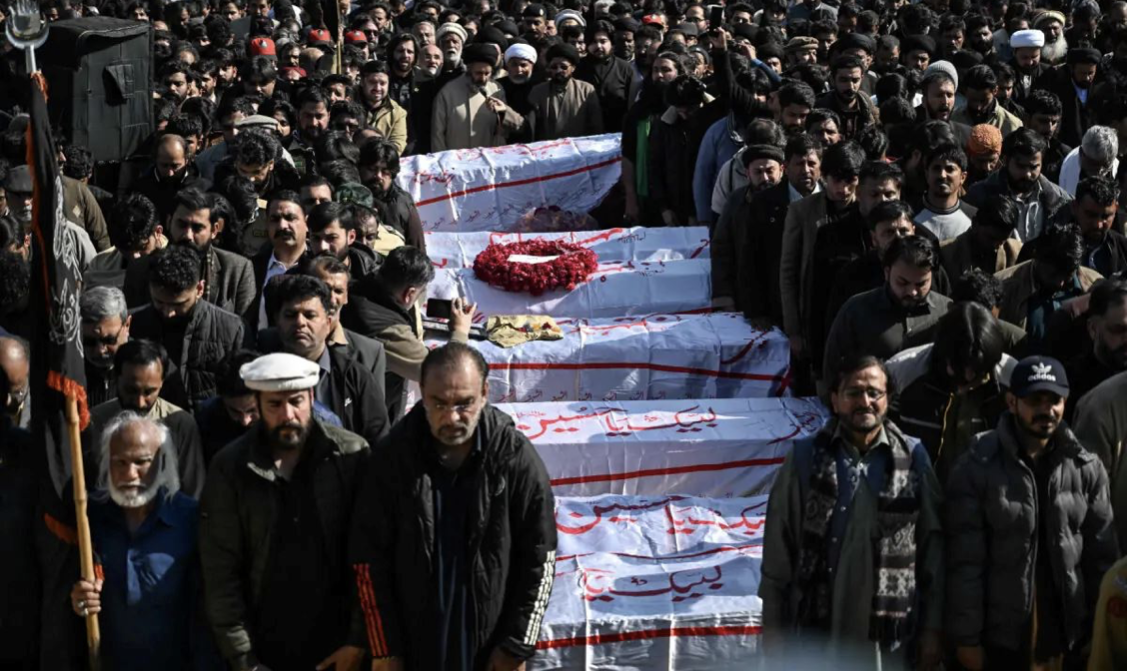
The suicide attack carried out on 6 February 2026 at a Shia mosque in the Trilayi area of Islamabad , the capital of Pakistan , which claimed at least 31 lives and injured more than 160 people, was not merely an isolated incident but a reflection of the deep contradictions embedded within Pakistan’s state formation, political economy, and democratic evolution. This tragedy not only resulted in the loss of precious human lives but also exposed the failures of the state’s security apparatus. Occurring in the federal capital, the attack raised serious questions about the state’s authority, sovereignty, and monopoly over legitimate violence. The ruling elites have consistently argued that the state is the institution that holds a monopoly over legitimate violence; when non-state actors continuously challenge that monopoly, the legitimacy of the state itself is weakened. In this context, the critical question arises: are such incidents simply security failures, or are they symptoms of an internal crisis within the structure of the state?
The history of suicide attacks in Pakistan clarifies the roots of this problem. The first major suicide attack occurred in the mid-1990s, but the trend intensified significantly after 2001, when Pakistan joined the global “war on terror” following the U.S. invasion of Afghanistan. Between 2007 and 2009, more than two hundred suicide attacks were recorded, including the assassination of Benazir Bhutto (2007), the Islamabad Marriott Hotel bombing (2008), the Army Public School Peshawar attack (2014), and numerous assaults on mosques and imambargahs (Shia prayer halls). According to official and unofficial figures, approximately 80,000 Pakistani civilians, soldiers, and police personnel have lost their lives to terrorism since 2001. This human toll is not merely a statistical record but a sign of deep fractures within the national social fabric. The 6 February 2026 attack, in which an estimated four to six kilograms of explosives and ball bearings were used, is part of this historical continuum.
The economic consequences of these attacks have also been profound and long-lasting. During the peak years of terrorism, foreign investment declined, defense expenditures increased, development budgets were redirected toward security operations, and commercial and tourism activities slowed considerably. According to the World Bank (2015), terrorism significantly affected Pakistan’s economic growth. Socially, the expansion of militarized surveillance in public spaces, the erosion of civil liberties, the growth of sectarian distrust, and the spread of fear and uncertainty among the youth have reshaped everyday life. Security measures are no longer temporary responses but have become a permanent feature of daily existence, adversely affecting civil freedoms and the democratic process.
The structural causes of the state crisis include geopolitical dynamics, civil-military imbalance, economic dependency, and political exclusion. Militant networks formed during the Afghan jihad later evolved into internal threats, and the unintended consequences of past policies have contributed to the severe crises of the present. Military interventions in 1958, 1977, and 1999 weakened political institutions, while the absence of genuine civilian rule undermined democratic consolidation. Within the global capitalist system, semi-peripheral states often lack economic sovereignty, and Pakistan’s dependence on IMF programs has constrained domestic policymaking. As political participation became limited, dissatisfaction was driven underground. The suppression of political expression created fertile ground for extremism.
In Pakistan, trends of securitization and democratic contraction are no longer matters of analytical exaggeration but established political realities. After every major attack, the expansion of surveillance powers, tighter media restrictions, and limitations on public gatherings have been presented as temporary and necessary measures. Yet through repetition, these extraordinary measures have become normalized as routine governance. Gradually, the logic of security has overtaken the logic of politics, pushing the democratic process into a permanently defensive posture.
It was within such historical contexts that the prominent Marxist theorist Leon Trotsky placed the concept of the “Revolutionary Constituent Assembly” at the center of debate. For Trotsky, when an existing constitutional structure loses its capacity to absorb and resolve the class contradictions within society—when state institutions merely freeze the balance of power and legal continuity becomes a guardian of social stagnation—mere reforms become insufficient. At that point, the need arises for an assembly that does not simply amend constitutional provisions but restructures the foundations of the state, transfers the source of power, and transforms the social basis of authority.
Viewed through this theoretical lens, Pakistan’s imbalanced civil-military relations, unresolved questions of provincial autonomy, absence of economic justice, ambiguities in judicial and parliamentary authority, and centralizing tendencies appear unlikely to be resolved within the framework of a conventional constitutional process. A “simple” or traditional constituent assembly typically seeks to preserve constitutional continuity while clarifying powers, strengthening parliamentary sovereignty, safeguarding minority rights, and improving accountability mechanisms, as seen in other transitional contexts. However, where the very structure of state power rests upon class and institutional imbalance, the scope for reform becomes limited.
For this reason, the idea of a Revolutionary Constituent Assembly is not merely about constitutional amendment but about the social transfer of power. Such an assembly would recognize the right of self-determination of oppressed nationalities, including the right of secession; ensure public ownership and democratic oversight of economic resources; and dismantle the structure of power shaped by the alliance of capitalist profit, feudal domination, and military supremacy. This vision rejects a state and economic model in which public service institutions are privatized and handed over to capital, natural resources are auctioned for profit, and society is divided along religious, gender, or identity lines to fragment political consciousness.
The essence of a revolutionary assembly lies in transferring power from centralizing elites to workers, peasants, students, women, and the conscious segments of the middle class. It would not be a symbolic or decorative forum but a dynamic and continuously advancing process that treats “workers’ control” not as a slogan but as a governing principle. Through democratic control of factories, fields, universities, and public institutions, the economy would be subordinated to social need rather than private profit.
Such an assembly would aim not merely to alter constitutional language but to transform relations of power. It would dismantle centralizing structures that suppress local and class autonomy, laying the foundation for a federal democracy built upon voluntary unity, economic equality, and social justice. In this vision, the legitimacy of the state would arise not from control in the name of security but from popular consent, economic participation, and democratic authority.
Ultimately, if the crisis of the state is not merely an administrative failure but the manifestation of structural contradiction, then its solution cannot lie in administrative reform alone. A genuine Revolutionary Constituent Assembly would be one that transforms the class basis of power, turns the people from mere voters into decision-makers, and frees society from exploitation, centralization, and profit-driven domination, moving toward a socialist society—one in which the state is not the guardian of coercive power but the organized expression of collective welfare.
References
Reuters. (6 February 2026). “Explosion rocks Shi’ite Mosque in Islamabad: dozens killed.
” South Asia Terrorism Portal (2023). Pakistan Terrorism Data Portal.
Trotsky, L. (1930). On the Spanish Revolution.
World Bank. (2015). Pakistan Economic Update.


