Imperialist pressure increases Mexico’s subordination and social polarization
=
Caludia Sheinbaum and Mexico’s Subordination to Trump’s Economic Policy
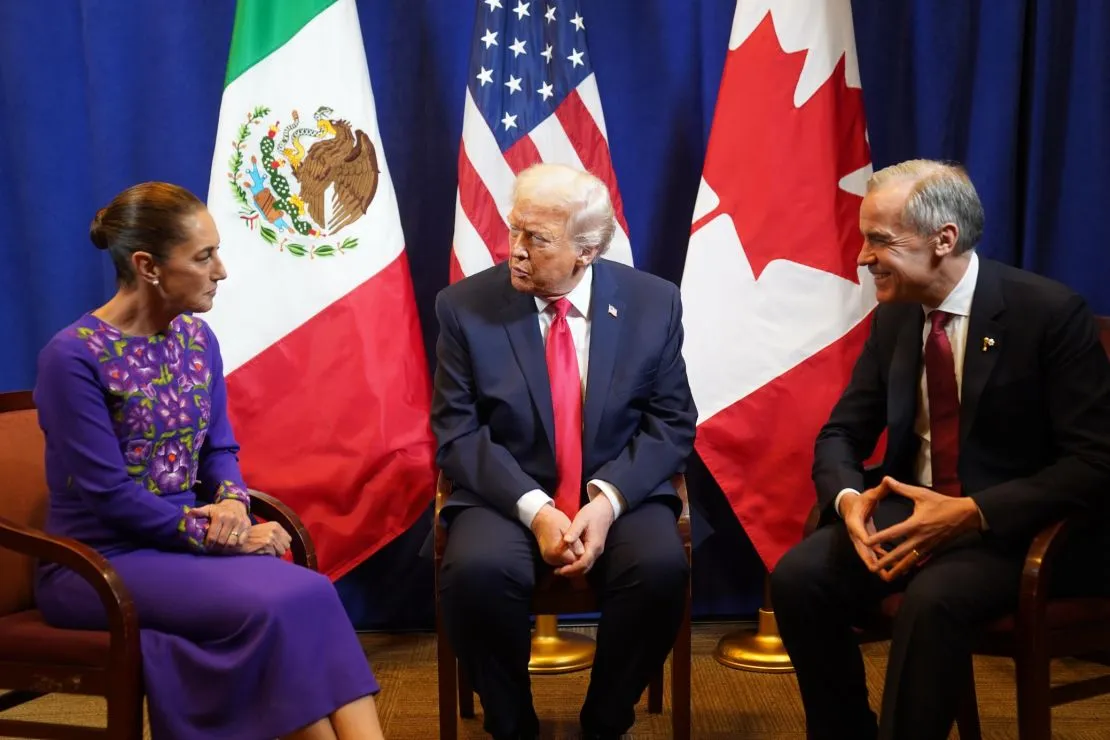
Donald Trump’s second term has further reconfigured the imperialist relationship of domination between the United States and Mexico. Rather than confronting Washington over national sovereignty, Claudia Sheinbaum’s government has chosen to actively adapt to its economic, commercial, and geopolitical demands. Despite its rhetoric “in defense of sovereignty,” Sheinbaum’s government systematically yields to these pressures and reproduces them on exploited Mexican sectors, further subjugating the country within the framework of Trump’s new version of the Monroe Doctrine.
One of the central pillars of this relationship of domination is trade policy. Since the beginning of his new term, Trump has used tariffs as a tool for direct pressure. In June 2025, he imposed general tariffs of 25% on goods not covered by the United States-Mexico-Canada Agreement (USMCA), the replacement for the North American Free Trade Agreement (NAFTA), 25% on automobiles, and up to 50% on steel, aluminum, and copper. These measures were based not only on economic criteria but also on political demands, such as immigration control, intensifying the “war on drugs,” and aligning with the U.S. offensive against China.
The impact of these measures on the Mexican economy was immediate. The Bank of Mexico revised its growth forecast for 2025 downward from 0.6% to 0.3% amid a growing risk of economic stagnation (Bank of Mexico, 2025).
Since Mexican industry heavily depends on the U.S. market, the tariffs affect not only exports, but also reconfigure production chains, put pressure on wages, and shift the costs of the trade dispute to the working class. Mexico exports approximately 76% of its finished steel to the United States. In 2025, exports from the automotive sector fell by nearly 6%, while other manufacturing sectors experienced year-on-year growth of around 17%. This reflects an uneven reorganization of production based on the needs of U.S. capital. This confirms that Washington’s strategy is not to break with Mexico but to integrate the two economies more deeply and hierarchically.
But the problem goes much deeper than trade policy. Over the last five decades, production value chains in both countries have been integrated with a clear hierarchy, crossing the U.S.-Mexico border multiple times before a product reaches the end consumer. The goal is not only to reduce costs for U.S. companies but also to strengthen their competitive capacity against China, the United States’ main strategic rival. This industrial network is poised to play an even more significant role in the face of competition from China, a formidable commercial rival with the capacity to produce on a larger scale. Trump’s Project 2025 and National Security Strategy emphasize the need to relocate production from China to the “Western Hemisphere” and consolidate a regional production bloc under U.S. leadership that can rival the new Asian imperialism. As we will see, the entire economic policy of the Sheinbaum administration, as outlined in the “Mexico Plan” in early 2025, is essentially the “Mexican corollary” to the “Trump corollary” of the Monroe Doctrine.
Mexico occupies a key position in this context as a territory for the relocation of production (nearshoring) under U.S. control. President Claudia Sheinbaum’s January 2025 Plan Mexico aims to attract massive domestic and foreign investment through over 2,000 registered projects. The plan seeks to raise the investment-to-GDP ratio above 25% by 2026 and generate 1.5 million additional jobs.
However, this plan has only been partially and unevenly implemented so far. Rather than constituting a sovereign development strategy, its implementation primarily responds to the needs of U.S. capital to relocate production.
In January 2026, GM Mexico announced that it would invest $1 billion from 2026 to 2027 to convert its plants to manufacture electric vehicles. This decision does not demonstrate a commitment to developing the Mexican industrial sector; rather, it is a defensive reaction to growing competition from Chinese manufacturers in the domestic market. BYD, a Chinese multinational and currently the world’s largest producer of electric vehicles, nearly doubled its sales in Mexico in 2025, accounting for 60-70% of the country’s hybrid vehicle sales. Following this announcement, Pilgrim’s Pride, a U.S. multinational specializing in the poultry industry, announced an investment of $1.3 billion between 2026 and 2030 to modernize its Mexican plants.
Although the Mexican government has indicated that the national investment portfolio amounts to approximately $277 billion, this sum is insufficient to reach the official target of investing 25% of the GDP by 2026. In 2025, investment represented around 22% of GDP, down from 24.8% in 2024, reflecting persistent economic uncertainty at the national and regional levels.
Beyond these figures, the key point is that the investments promoted by Plan Mexico primarily respond to the needs of U.S. capitalism’s reshoring. This reshoring constitutes a recolonized proletariat, not a project oriented toward the needs of the Mexican population and the advancement of national sovereignty.
Another aspect of Plan Mexico is the adoption of trade measures that align with the U.S. offensive against China. The Mexican government announced tariffs on more than 1,400 Chinese and other Asian products, including textiles and footwear. These measures will directly affect China, which is Mexico’s second-largest trading partner. Bilateral trade between the two countries exceeded $130 billion in 2024, accounting for around 20% of Mexican imports. Rather than strengthening an autonomous industrial policy, these measures confirm that Mexico is a functional piece in the inter-imperialist competition between the United States and China, further solidifying its status as a dependent economy.
The United States-Mexico-Canada Agreement (USMCA), which successive Mexican governments have presented as a platform for stability and certainty, functions as a mechanism of domination in practice, tying the Mexican economy to the strategic needs of U.S. capital. Rather than guaranteeing a symmetrical relationship, the treaty consolidates a pattern of insertion based on cheap and flexible labor regulations and productive subordination within value chains dominated by the United States.
Although around 85% of Mexican exports to the United States currently enter duty-free under the USMCA, this is not a structural guarantee. The constant threat of new tariffs acts as a political pressure tool that limits the Mexican government’s room for maneuvering. The agreement provides for a mandatory review in 2026, but this process has already been rendered meaningless. On January 13 of this year, during a press conference at a Ford plant in Detroit, he made it clear once again: “I don’t even think about the USMCA. I mean, I want Canada and Mexico to do well. But the problem is, we don’t need their products. We don’t need cars made in Mexico. We want to make them here.”
In the face of such blatant contempt, Claudia Sheinbaum’s government’s response is telling. Rather than denouncing the extortionate nature of the tariffs or questioning the treaty’s structural asymmetry, the Mexican administration insists on maintaining the fiction of negotiations between equals. In October 2025, Economy Secretary Marcelo Ebrard stated that the preparatory talks for the USMCA review were “about 90% complete,” following over 80 bilateral meetings. He admitted that these were not final agreements and that the USMCA would be renegotiated under even less favorable conditions. Similarly, in response to Trump’s outburst in January of this year, Sheinbaum replied, “I am convinced, therefore, that the trade relationship with the United States will continue. The economies of Mexico, the United States, and Canada are highly correlated. Those who most defend the USMCA are American businessmen.”
At no point has the government or the bourgeois analysts who echo it stood up to defend an independent economic policy that would allow the country to be reindustrialized to meet the needs of the working class and halt environmental destruction. Rather than proposing a strategy to break with this dynamic, the Sheinbaum government has presented itself as “the best-positioned country” in the face of Trump’s tariff war—that is, as the partner most willing to quickly and deeply yield to Washington’s demands.
From a historical perspective, Mexico’s submission to U.S. imperialist interests is not new. It is part of a long tradition of Latin American bourgeois subordination, including progressive governments. Despite their differentiated rhetoric, these governments have demonstrated an inability to break with this pattern. In the Mexican case, the current government reproduces this pattern in a more sophisticated, yet familiar, form: Cardenismo. It combines a nationalist and progressive discourse with a practice of dependent integration, administering subordination rather than mobilizing the country’s social forces to confront it.
Mexico is consolidating its role as the gendarme of U.S. imperialism
The militarization of the border between Mexico and the United States is one of the most visible and persistent aspects of the Mexican state’s subordination to U.S. imperialist policy. During Donald Trump’s second term, this process deepened and took on a qualitatively new character. From the beginning of the new U.S. administration, Trump resumed and radicalized his anti-immigration agenda. He presented migration as an “invasion” and a national security problem. This served as justification for an unprecedented crackdown. It combined the direct deployment of U.S. armed forces on the northern border with an increased externalization of immigration control toward Mexican territory. Since then ICE patrols have been operating with total impunity, murdering, threatening, and detaining immigrants and citizens without respect for the law.
A central element of this offensive was the establishment of new military zones along the southern border of the United States in early 2025. These zones, officially called “National Defense Areas,” cover approximately 400 kilometers and are under the direct control of the Pentagon. Located in Arizona, Texas, New Mexico, and El Paso, these zones allow the U.S. Armed Forces to detain migrants without resorting to special laws, such as the Insurrection Act of 1807, which normalizes military intervention in civil control tasks. It is estimated that more than 9,000 U.S. soldiers are currently deployed at the border: About 4,200 are under federal orders, and approximately 5,000 are from the National Guard and under the control of state governors. This contingent is supported by more than 100 Stryker armored vehicles, surveillance drones, spy aircraft, and at least two Navy ships that have been deployed for coastal monitoring.
This process must be understood in the context of the Mexican state’s role. While the United States is reinforcing its border with an overtly military approach, Mexico is taking on the complementary role of containing threats from the south and north of its territory.
In February 2025, Claudia Sheinbaum’s government agreed to deploy 10,000 new National Guard troops to border states as part of an agreement with the Trump administration that suspended 25% tariffs on Mexican exports for one month. This reinforcement was added to a previous contingent of over 50,000 troops in states such as Tamaulipas, Chihuahua, Baja California, Sonora, Coahuila, and Nuevo León. This brings the total number of forces involved in immigration control and border security to nearly 60,000.
The logic behind this deployment is unambiguous. Although official discourse insists that the aim is to combat drug trafficking and ensure security, government announcements acknowledge that the primary objective is to reduce the number of migrants crossing the border. In effect, Mexico is acting as the front line of containment for U.S. immigration policy, detaining, dispersing, and deporting people before they reach the northern border. Mexico’s role as the regional policeman is not new; it was already established during Andrés Manuel López Obrador’s administration. However, under Sheinbaum, this role is being maintained and expanded as a bargaining chip in trade and diplomatic negotiations.
Border militarization also includes an increasingly sophisticated technological and business network. Israeli companies that specialize in military and surveillance technology, such as Elbit Systems, are involved in installing monitoring systems, “smart” walls, and control devices on both the U.S. and Mexican sides of the border. These technologies were developed and tested in contexts of occupation and population control in Palestine. They transform the border into a laboratory for waging war against migrants and reinforce a logic of migratory apartheid.
Not only does militarization criminalize migrants, it also normalizes the military’s role in population control and serves to divide and increase the exploitation of the working class. People fleeing poverty, violence, or unemployment—phenomena largely produced by the United States’ own economic and geopolitical policies in the region—are treated as threats to security. Meanwhile, capital crosses borders unchecked, and the structural causes of migration remain intact.
The “war on drgus” is an imperialist pretext for militarization and social barbarism
It is one of the historical pillars of U.S. imperialist intervention in Mexico and Latin America. Rather than being a policy aimed at solving a public health problem or reducing violence, it has functioned as a means of territorial control, militarization, and social control.
During Donald Trump’s second term, this strategy became more radical with the aim of regaining control over the cartels. Despite its critical rhetoric, Claudia Sheinbaum’s government has chosen to deepen cooperation with Washington, thereby reproducing the destructive effects of this policy on the working class and popular sectors.
The U.S. government has once again placed drug trafficking at the center of its regional agenda, using warmongering rhetoric that combines a false discourse of “national security,” racism, and explicit threats of military intervention. One of the most significant proposals is to declare so-called “cartels” foreign terrorist organizations. This would legally enable extraterritorial operations, expanded financial sanctions, and direct military action.
In Mexico’s case, this threat is coupled with Trump’s public statements about carrying out ground attacks against alleged cartel facilities within the country, which would flagrantly violate its sovereignty.
Mexico is a kind of “narco-state” in that sectors of the Mexican bourgeoisie indirectly benefit from drug trafficking and other illegal activities, such as fuel theft, money laundering, and human trafficking, through extortion. This is the result of the corporatism and clientelism inherited from the PRI regime.
Claudia Sheinbaum’s government has responded to this offensive with ambiguous rhetoric but clear actions. While maintaining that the drug problem must be addressed as a social and public health issue, her administration has intensified cooperation with Washington.
A key example of this subordination is the increase in extraditions of alleged organized crime leaders to the United States. During the past period alone, at least 29 individuals were extradited to U.S. courts, many of whom were high-profile figures. Although these extraditions are presented as gestures of cooperation, they actually reinforce Mexico’s judicial and political subordination by transferring the administration of justice to the United States.
Likewise, the deployment of federal forces in internal security operations has increased. This is due to Mexican cartels suffering attrition in their confrontations with the armed forces, forcing them to recruit and train young people. According to one report, there are an estimated “20 to 30 thousand minors working as hitmen.” Security Secretary Omar García Harfuch led the offensive against the Sinaloa Cartel, which involved the deployment of hundreds of soldiers and federal forces. Rather than reducing violence, these actions tend to provoke internal disputes between criminal factions, resulting in spikes in armed clashes and increased civilian casualties. The capture and subsequent extradition of Ismael “El Mayo” Zambada is an example of this, as it triggered an escalation of violence in cities such as Culiacán.
The social consequences of this strategy are devastating. Currently, Mexico has more than 125,000 missing persons, and approximately 2,700 clandestine graves have been documented throughout the country. The discovery of an extermination camp in Jalisco with over 500 bodies and underground crematoria highlights the extent of the social barbarism associated with militarization and the criminal economy (Jalisco State Attorney General’s Office, 2025). The discovery of this camp highlights the extent of the social barbarism associated with militarization and the criminal economy.
This violence has a clear class bias; the impoverished, precarious youth, indigenous communities, and women bear the brunt of the terror while large sectors of the bourgeoisie benefit directly or indirectly from this criminal economy.
One element systematically hidden by the official narrative is the role of U.S. imperialism in reproducing drug trafficking. The United States is not only the main consumer market for drugs but also a key player in supplying weapons and laundering money associated with these networks. Over the past decade, 74% of illegal weapons confiscated in Mexico originated from U.S. states such as Texas, Arizona, and Florida.
Likewise, the complicity of U.S. agencies is no secret. There are documented cases of collaboration between U.S. agencies and drug trafficking organizations. For example, in the 1980s, the U.S. financed the Nicaraguan Contras through drug trafficking. More recently, there have been cases involving DEA and FBI officials.
Thus, the “war on drugs” is neither a moral crusade nor an effective security policy, but rather a selective instrument that criminalizes popular sectors while preserving the strategic interests of imperialism and local elites. Since 2006, the war on drugs has justified the militarization of the Mexican state under Calderón and has been financed by the U.S. Subsequent governments, including progressive ones, did not break with this logic.
The limits of the Fourth Transformation (4T)
Mexican society has experienced tremendous economic inequality and social injustice for many decades. Throughout our history, there have been enormous uprisings, revolutions, and permanent resistance. The most recent uprising began in 2014 when the Mexican people confronted this injustice once again. The trigger was undoubtedly the state crime against the 43 students from Ayotzinapa. The immense wave of indignation and mobilization produced a radical change in the situation. This was followed by the teachers’ strike against the neoliberal “education reform” in 2016, as well as the Nochixtlán massacre. A high point in this process was the massive uprising against the “gasolinazo” (gas price hike) in 2017, when hundreds of popular assemblies and local rebellions emerged and hundreds of thousands of people took to the streets across Mexico, shouting, “Peña out!”
Terrified, the “power mafia,” the “rapacious minority,” decided to “take off some rings to save their fingers.” They appealed to López Obrador to embody the “hope of Mexico.” They left out the fact that, years earlier, AMLO himself had stigmatized them as a “danger to Mexico.” In case there was any doubt, AMLO explained to Mexico’s leading bankers, gathered at the opulent Hotel Prince in Acapulco, that if not him, then who would tame the tiger?
Today, with his six-year term over and in the “Second Stage” of the “Fourth Transformation,” the palliative assistance to the most impoverished sectors—which was received with relief and gratitude at the beginning of his term—no longer compensates for the discontent of other large groups of workers and the exploited. These groups work long hours and generate enormous wealth while remaining in precarious conditions. Scholarships and other forms of assistance have not solved the lack of prospects for most young people, who have only informal jobs, unstable employment, or “junk” contracts that violate labor laws and rights. These contracts offer no social security or benefits, require long hours with no respect for end times or breaks, and prevent access to housing. Low wages make it difficult to pay rent. There is also the frustration of those who have completed their studies after making great sacrifices for their families and cannot find work related to their field, only finding precarious “chambas” (odd jobs).
The expectations for improvement generated by AMLO’s government are turning into disappointment, uncertainty, and mistrust. The people’s “hope” is turning into anguish and apathy and giving way to weariness. This disappointment has not yet led to mass action by the exploited due to the brutal restraint of the union leadership, which is loyal to the ruling power. It has also not led to mass action because the masses distrust the right wing, which is now a “rabid opposition.”
Why is this happening? Because the changes were superficial, not fundamental. Although the president and ruling party changed, the regime did not. It continues to serve the oligarchs. To make matters worse, many disliked figures from the PRI and PAN switched parties to join the ruling Morena party. Despite the slogan “For the good of all, the poor first,” it was the big magnates who doubled their fortunes first.
The country’s semi-colonial subordination did not change either. Foreign debt grew to nearly half (49.9%) of the gross domestic product. The yoke of NAFTA, signed in 1992, proved to be an instrument for plundering the country’s wealth and ruining the peasantry. This was reinforced with the signing of the USMCA in 2018. Meanwhile, the DEA’s and Trump’s interference continues to grow in relation to their supposed “fight against drug trafficking.” The decadent imperialist magnate has no shortage of excuses when collusion between organized crime and many governors, mayors, deputies, and senators is exposed.
The manipulation of TV Azteca, Trump and PAN
As has happened before in other countries on the continent, TV Azteca, Trump, and the PAN manipulate the situation. Argentina, Brazil, Venezuela, Ecuador, etc. Faced with the failure of governments that call themselves “progressive” or even “leftist,” the old reactionary political sectors that ruled Mexico for more than 80 years feel that “the time for their revenge” has come. Some of those same oligarchs are using their powerful media outlets to manipulate popular unrest and anger among the rural and urban middle classes. They manipulate by trying to channel it in a direction as ultra-reactionary as their own capitalist interests, which, in reality, go against the interests of the majority of the protesters, even if the protesters are unaware of this fact.
We won’t describe the reasons for Ricardo Salinas Pliego’s anger in this article. He owns Banco Azteca and the Electra commercial network and refuses to pay almost $3 billion in taxes owed for many years. Salinas Pliego supported AMLO’s election campaign, which is why his bank received favors from those in power during the last six-year term. Instead of paying his debts to the state, he is spending millions to manipulate the opposition media. We will not dwell on the “evidence” presented by Luisa María Alcalde, president of Morena, regarding the contract that the PAN signed with a young “Generation Z” man who organized the November 15 march. It is also unproductive to delve into the plot of so many other setups and provocations. They are part of the “dirty war” between the parties of the rotten regime, which serve the capitalist oligarchs and not “the poor.” We repudiate this quarrel between exploiters who use the exploited. The real struggle, for us, is not between the letters 4T and Z, but between the exploited and oppressed and all exploiters and oppressors!
The legitimahe struggles of various social sectors
We support the legitimate struggles of various social sectors with all our modest strength. We support the direct actions of sectors such as the CNTE teachers’ strike and sit-in over the lack of response to their demands, supported by the majority of workers in different sectors. We support the repeal of the neoliberal ISSTE Law of 2007, as well as a solidarity-based pension system and a larger budget for education, health, and social security. The blockades by thousands of farmers in several states who have been harmed by the USMCA and are fed up with the parasitism of cartels that impose a “criminal tax” on them have a major economic and social impact in Mexico. The organizations that make up the coalition have called for new road blockades and joint action with freight transporters. They are fighting against large intermediaries, such as Maseca, and other corporations. They are demanding a support price for corn, the price of which is set on the Chicago Stock Exchange and subsidized in the US. In Mexico City, there has also been a struggle against genetic engineering. There has also been a struggle against gentrification and housing evictions in Mexico City.
Meanwhile, outrage is growing among the hundreds of thousands of people affected by flooding in Veracruz and other states due to government neglect at all levels. There is also uncertainty among Pemex workers in Poza Rica regarding the paralysis of the production plant caused by the floods. Mexico ranks fourth in the number of murders of environmental and social defenders or activists. This is why the movement against the criminalization of social movements is crucial. The Ayotzinapa case, for example, has revived memories of student and working youth struggles, as well as the traditions of the 1960s and 1990s. In this context of environmental collapse, the struggle of the water technology workers of SITIMTA stands out. They are resisting the privatization of water resources, which would benefit transnational corporations such as soft drink and beer companies, as well as large landowners. They are also fighting against the growing contamination of aquifers by Pemex and other extractive corporations.
The trigger that inflamed the masses of Michoacán in this context of growing tensions was the point-blank murder of Carlos Manzo, the municipal president of Uruapan. Manzo was confronting both the cartels and the Morena governor of Michoacán, Alfredo Ramírez Bedoya. The mayor rose through the ranks of Morena, serving as a federal deputy before breaking with the party, running as an independent candidate, winning, and preparing to run for governor. Adding to the outrage, scandals have erupted involving the collusion of some high-profile Morena figures with drug traffickers, including Senator Adán Augusto, who is close to AMLO, and other high-ranking Navy officials, who are relatives of the former SEMAR secretary and are implicated in fiscal and hydrocarbon “huachicol” (fuel theft).
The government has not addressed any of these demands. However, it does comply with the demands of imperialism and local oligarchs, who impose plans that further exploit and plunder the country. These shortcomings and grievances are changing the country’s political situation. We do not intend to provide a definitive opinion on an ongoing and incipient process. However, one thing is clear: the “Second Floor of the 4T” is showing cracks.
To achieve true sovereignty, we must achieve political independence for workers
Analyzing the relationship between Mexico and the United States during Donald Trump’s second term, as well as Sheinbaum’s government’s response, leads to one central conclusion: there is no progressive way out within the framework of imperialist subordination or through the “realistic” administration of dependence. Cautious diplomacy, cooperation on security matters, and adaptation to the US trade war do not effectively defend sovereignty or improve the living conditions of the majority.
The Sheinbaum administration combines formal statements against interventionism with systematic concessions, such as deepening the USMCA, aligning with Trump’s trade policy, militarizing borders, and cooperating on intelligence and extraditions in the context of the “war on drugs.”
This contradiction is not accidental, but structural. Progressivism governs dependent economies that are integrated into the global market in a subordinate manner. Progressivism seeks to reconcile incompatible interests: containing social discontent on the one hand and guaranteeing the stability necessary for the reproduction of capital and fulfilling commitments to imperialist powers on the other. The result is a policy of managing conflict, not transforming it, which leaves the mechanisms of domination and exploitation intact.
Trump’s imperialist offensive, expressed through threats of military intervention, tariff blackmail, criminalization of migration, and expansion of militarization, highlights the impotence of this strategy. In the face of overt imperialism, diplomacy without social support is insufficient. Declarations of principles and appeals to international law or the “international community” have not stopped intervention in Venezuela, genocide in Gaza, militarization of the border, or direct threats against Mexico.
To achieve social justice and national independence without falling back into false alternatives or being used as unwitting instruments in power struggles between the wealthy elite, we must build an independent political alternative led by workers. This alternative must lead the struggles of all exploited people and not only demand a portion of the wealth we produce from the bosses’ government, but also establish a workers’, peasants’, and popular government. Building a workers’ alternative requires breaking with the passivity that union bureaucracies perpetuate. In the face of militarization and imperialist advances, it is crucial for trade union federations, militant unions, the student movement, and popular organizations to play an active role. This means not only speaking out, but also mobilizing and organizing work stoppages, strikes, and coordinated actions. It means creating spaces for organization with workers’ democracy and class independence to confront both external threats and the internal policies that make them possible.
We must formulate an independent political alternative from the struggles of our class: a program for true Mexican independence and national sovereignty in the face of the climate emergency. This program must fundamentally challenge the pillars of U.S. imperialist policy—the war on drugs, the criminalization of migration, and the militarization of social life—without fostering expectations in rival imperialisms, such as China’s. This requires proposing measures excluded from official debate: demilitarizing the country, withdrawing the army from internal security, legalizing drugs to dismantle criminal enterprises, and reorienting military spending toward health, education, housing, and employment. Those of us in the Socialist Workers’ Current are committed to this task, and we call on you to contribute to it.