search

Massacre in Pakistan-Administered Kashmir

Massacre in Pakistan-Administered Kashmir
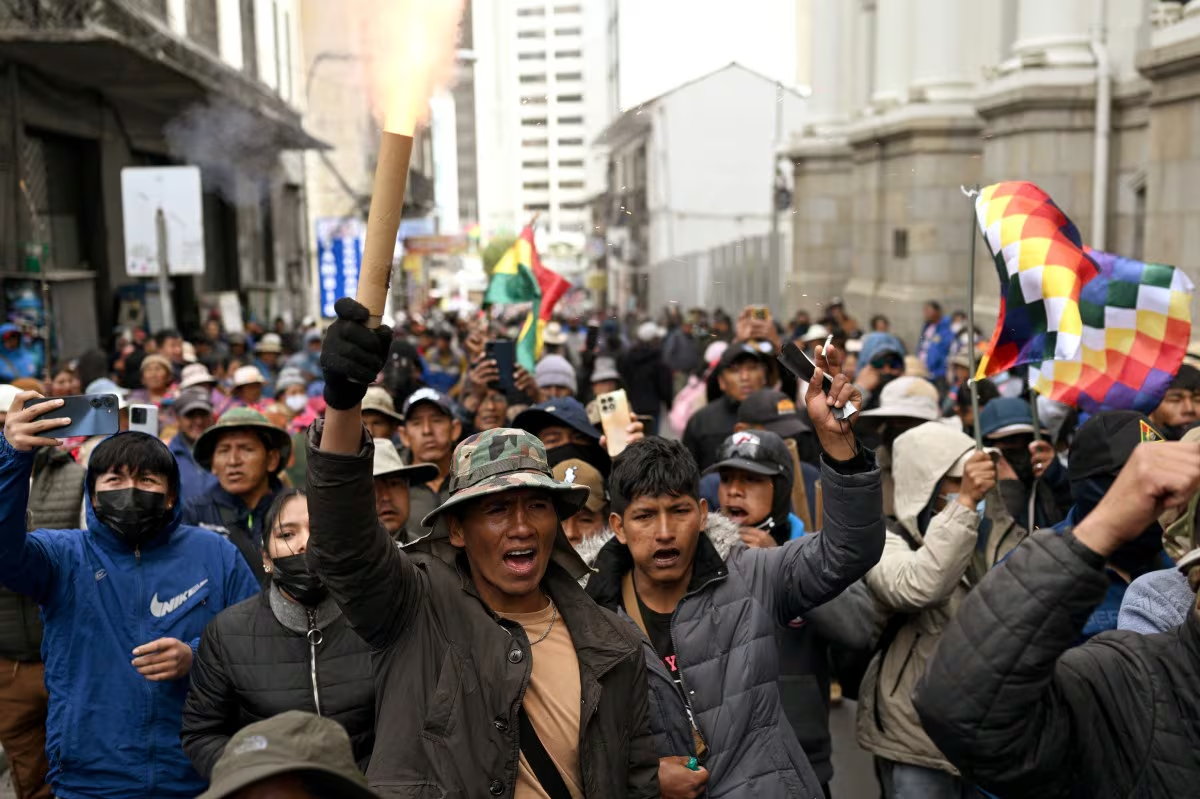
The most violent episode in the current crisis occurred on June 7, 2026, after protesters organized a funeral (of a activist of JAAC was killed by security forces) and were protesting peacefully, using the funeral gathering as a platform to demand justice and the implementation of their rights. The funeral was transformed into a scene of bloodshed outside the Combined Military Hospital in Rawalakot. In a move that has drawn widespread condemnation, security personnel opened fire and resorted to shelling against the unarmed mourners. According to the JAAC’s official account, at least 27 protesters were killed during the operation, while several others sustained serious injuries. Some local sources have suggested that the death toll could be over 100. it is fact by those were present that approximately 110 locals were detained from the hospital premises and that several people remain missing following the security operation. Authorities have been accused of taking custody of the bodies of deceased protesters, preventing families from performing last rites and further deepening the trauma inflicted upon the community.

Special Palestine

See more
The Release of Thiago Ávila and Saif Abukeshek

The Release of Thiago Ávila and Saif Abukeshek

After ten days of being held captive and subjected to torture and abuse at the hands of the genocidal state of Israel, the coordinators of the Global Sumud Flotilla (GSF), Thiago Ávila and Saif Abukeshek, were finally released this week and were able to return to Brazil and Spain, respectively. The crowd that greeted them highlighted the strength of the international mobilization and the relief felt, in Thiago’s words upon his arrival, at the “rectification of a violation.”
Featured
What Does Unconditional Support for the Palestinian Liberation Struggle Mean?

What Does Unconditional Support for the Palestinian Liberation Struggle Mean?

How can we defend unconditional support for the Palestinian liberation struggle—including the right to resistance—within the space of bourgeois democracy, especially when the government seeks precisely to suppress that support? The answer lies neither in adapting to the rules of the game nor in an abstract rejection of the legal arena. It is possible—and necessary—to use the very contradictions of bourgeois democracy against it. How can revolutionaries and those in solidarity with the Palestinian struggle use the formal freedoms of bourgeois democracy—freedom of speech, assembly, and the press; due process of law—to defend the right to self-determination, which includes, as the UN itself recognizes, “the struggle by all available means, including armed struggle”? This is the central contradiction we face. On the one hand, liberal democracies have been passing laws that equate anti-Zionism with anti-Semitism, criminalizing BDS, banning slogans like “from the river to the sea,” and persecuting activists. On the other hand, we know that abandoning the legal arena means abandoning the working class and the youth to repression without defense.
Europe
Who is Zé Maria?

Who is Zé Maria?

Longtime industrial union leader and political activist faces 2 years’ sentence for speech in defense of Palestinian liberation. His life story is the story of the Brazilian working class and pro-democracy movements.
Brazil

Vídeos

See more

Theory

See more
Our Promise to Akın Will Be Revolution!

Our Promise to Akın Will Be Revolution!

May 20th marks the 30th anniversary of the death of Akın Reçber; the Fourth Red Rose (Turkish: Dördüncü Kızıl Gülü) of May Day 1996, who died on May 20, 1996 as a result of the brutal torture he endured in police custody. Despite the brutal torture, Akın Reçber resisted to the end, and for thirty years his courage and determination have continued to live on in our struggle.
Featured
The Crisis of Chavismo and Social Catastrophe

The Crisis of Chavismo and Social Catastrophe

This article is a synthesis that contains parts of articles published in Correo Internacional in 2017 and 2019, as well as articles published on the LIT-CI website in 2020. Within the polemics of the different left currents, they tend to discuss the policies towards Maduro’s administration, the Constituent Assembly, and/or imperialism. But, unfortunately, little is […]
History

Opressions

See more

Partners